
CAD/BIM Tips & Tricks
The World’s Most Complex Highway Interchanges: Designed in BIM First
9 June 2026
Once upon a time, 3D design was, at best, considered “optional.” But modern interchanges have become so geometrically and operationally complex that 3D-first is no longer relegated to just being a choice.
The High Five interchange in Texas helped set the stage, acting as the early Jedi for the then-Padawans in 3D infrastructure modelling, something we increasingly take for granted.
When engineers were challenged to fix one of the busiest highway junctions in North Texas, they weren’t dealing with a minor traffic annoyance. They were facing a daily tangle of roughly half a million vehicles moving through the intersection of Interstate 635 and US Highway 75 in Dallas.
The existing interchange was a relic of the 1960s. It squeezed traffic, forced sharp slowdowns on looping ramps, and, in a country that drives on the right-hand side of the road, it introduced left-hand exits that tested even seasoned commuters.
In short, it was the kind of design that made drivers question both their safety and sanity.
It squeezed traffic, forced sharp slowdowns on looping ramps and, in a country that drives on the right-hand side of the road, it introduced left-hand exits that tested even seasoned commuters.
Something had to change. The groundbreaking answer here, and in other cases discussed below, was 3D. While 3D became mainstream in infrastructure design between 2009 and 2015, it was not yet commonplace when Texas urgently needed to upgrade the interchange. But, lacking the luxury of time, the infrastructure Jedi forged ahead, undeterred.
The Dallas High Five: A Vertical Solution to a Horizontal Problem
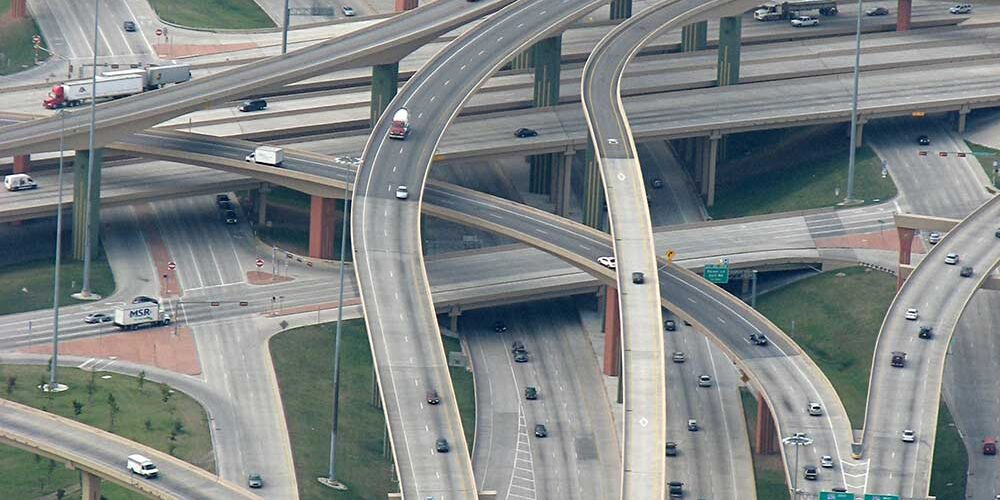
The solution became the Dallas High Five Interchange, a five-level stack structure that looks less like a road junction and more like a carefully choreographed concrete rollercoaster.
The design is necessitated by extreme urban density, where horizontal expansion is no longer viable. When you’re out of space, you’re out of space.
Completed in 2005 (four years before infrastructure 3D modelling became more common), the project included:
- 43 permanent bridges.
- 710 support columns.
- A height approaching 120 feet.
- A construction cost of roughly $261 million.
It opened more than a year ahead of schedule and went on to win the American Public Works Association’s Project of the Year award.
Popular Mechanics later described it as a “labyrinth of lanes,” which is an accurate description of the soaring, swooping, curvy nature of the High Five.
But beyond the scale and spectacle, what matters most for BIM and CAD professionals is this: The project was designed using detailed 3D modeling long before construction began.
In 2005, that was highly unusual, but it’s a decision that shaped modern design practices, enabling the future construction of some unimaginably complex infrastructure solutions.
Why 2D Breaks Down in Vertical Infrastructure
At ground level, traditional 2D drawings still work reasonably well. Straight roads, simple bridges, and flat intersections can easily be communicated on paper (or on a screen) without too much ambiguity.
But stack five layers of traffic into the same footprint and things get complicated quickly. Suddenly you’re dealing with:
- Vertical clearances measured in inches.
- Structural load paths that overlap across levels.
- Drainage systems that must function across multiple elevations.
- Ramps that curve, climb and intersect in three-dimensional space.
A design that looks perfectly acceptable in plan view can turn into a physical impossibility once built. Two ramps that appear separate on paper might end up occupying overlapping airspace in reality.
3D modeling is no longer optional. It’s essential. And if you need one good reason to wholeheartedly embrace 3D modeling for infrastructure, this is it: Clash detection, one of BIM’s core capabilities, allows engineers to identify these conflicts early.
Instead of discovering problems in the field, with concrete already poured, teams can resolve them digitally, where mistakes are quicker (and cheaper) to fix.
Building While Traffic Never Stops
One of the most impressive aspects of the High Five project was not just its design, but how it was built.
Construction took place while keeping traffic flowing through one of the busiest corridors in Texas. The approach relied on building new elevated structures above and around the existing interchange and then gradually shifting traffic onto them before removing the old system.
Roads, rail and buildings routinely occupy different elevations within the same footprint. Looking at this interchange, you can’t help but feel like you’re in a sci-fi movie.
This sequencing would have been virtually impossible to plan using only 2D documentation. With a 3D model, teams could visualize construction phases, simulate traffic flow, and troubleshoot and refine the approach before work began.
The result: fewer lane closures, improved safety and a project delivered ahead of schedule.
It turned out that when you can “see” the project before it exists, you tend to make fewer unpleasant discoveries later.
BIM in Infrastructure: From Advantage to Expectation
The High Five was not an isolated case. It marked a broader shift in infrastructure delivery.
Today, BIM is widely recognized as a standard approach for complex transportation projects. Governments and agencies across the UK, US and beyond increasingly require structured 3D workflows for major infrastructure programs.
Why? Because the benefits include:
- Improved coordination across disciplines.
- Reduced design conflicts.
- Better construction sequencing.
- Lower risk of costly change orders.
In large-scale projects, even small percentage improvements can snowball and translate into significant financial savings. Resolving issues digitally instead of physically is not only efficient but also economically significant.
In highly constrained projects, 3D is the only practical way to deliver a buildable design.
When Interchanges Go Even Further
If Dallas represents a benchmark, global infrastructure projects continue to push complexity to a level that seems almost purely theoretical until you see it built. And even then, some of the projects appear to have been designed by a raccoon on crystal meth.
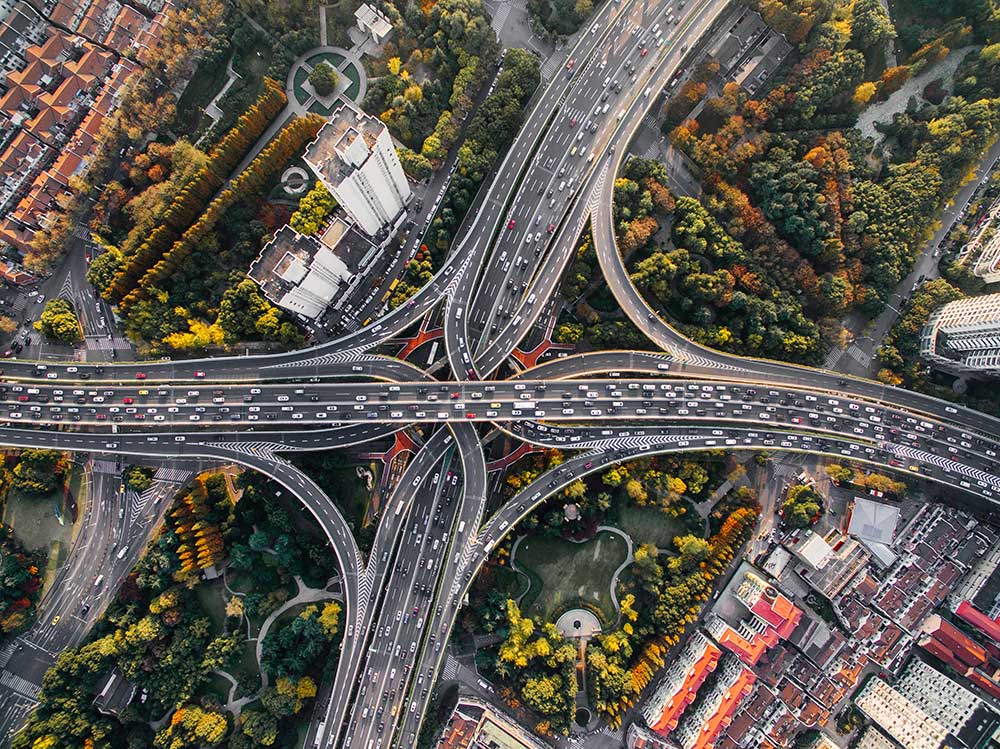
Take Shanghai’s Puxi Interchange. Located in the historic heart of the city, it connects the Yan’an Elevated Road with the North–South Elevated Road in a dense urban environment where space is at a premium. What makes it remarkable is its vertical stacking: It reaches six distinct levels, making it one of the very few true six-level stack interchanges in the world.
This is not just an engineering “curiosity.” The design is necessitated by extreme urban density, where horizontal expansion is no longer viable. When you’re out of space, you’re out of space.
But multiple transport layers had to coexist within the same footprint, often alongside pedestrian infrastructure and surface streets. In this situation, the interchange stops behaving like a traditional road system and starts looking like a three-dimensional network or web.
Why Stop at Six?
China has pushed this approach even further in cities such as Chongqing, where terrain and density combine to create unusually complex infrastructure challenges. One of the most cited examples is the Huangjuewan Interchange, a twelve-story-tall stack structure that connects multiple expressways and urban roads across a mountainous landscape.
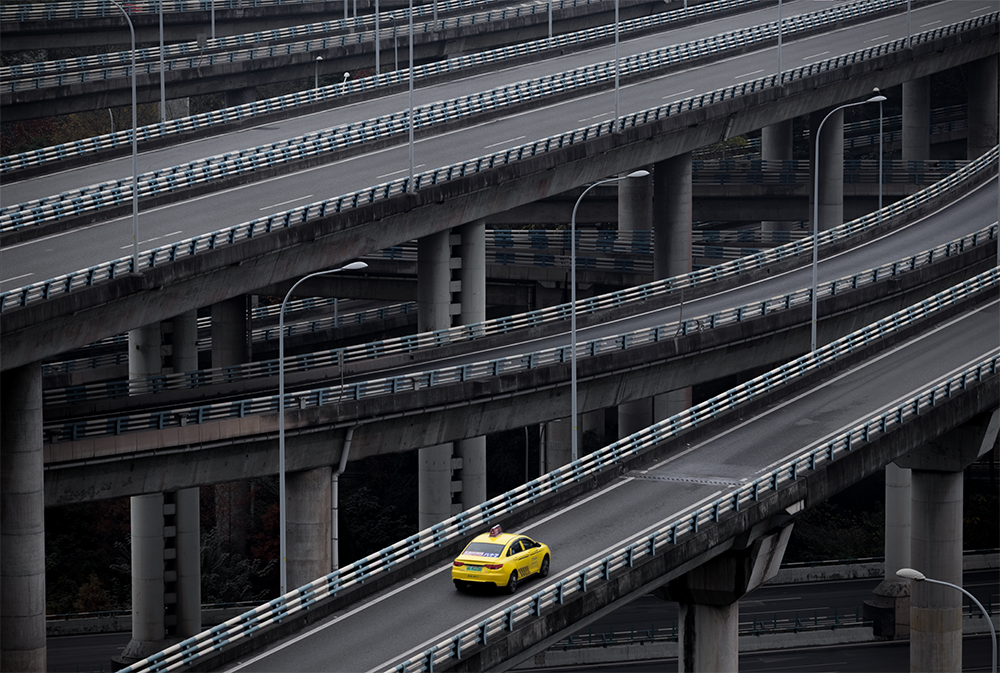
The interchange includes:
- Five vertical levels.
- Over a dozen directional ramps.
- Connections across multiple expressway corridors and local roads.
It took nearly a decade of construction and is often described as one of the most complex interchanges ever built. Designing it in 2D would have been a (bad) joke.
What makes projects like Chongqing particularly educational is not just their geometry, but their context. The city itself is built across steep terrain with layered infrastructure, where roads, rail and buildings routinely occupy different elevations within the same footprint. Looking at this interchange, you can’t help but feel like you’re in a sci-fi movie.
In these environments, traditional 2D design is not merely inefficient. It’s fundamentally “inadequate.” Frankly, “disastrous” is probably more appropriate.
In at least one documented case, a critical structural conflict at a bridge pier was identified and resolved in the model before construction began. Without BIM, that issue would likely have surfaced on-site, with far greater consequences, delays and costs.
Where BIM Becomes Non-Negotiable
Projects of this scale and density rely heavily on advanced 3D workflows. While specific software stacks vary, the underlying approach is consistent:
- Reality capture defines existing geography and constraints.
- Parametric modeling drives roadway geometry.
- Structural and civil systems are developed in parallel.
- Collaborative models enable continuous clash detection.
- Construction sequencing is simulated before breaking ground.
In highly constrained projects like those in Shanghai and Chongqing, this level of coordination is not merely a competitive advantage. It is the only practical way to deliver a buildable design.
When your interchange has five or six levels, discovering a conflict in the field is no longer an inconvenience. It is a very expensive lesson in why 3D should come first.
What “3D First” Actually Means
A true 3D-first workflow is not just about visualization. It’s about building a data-rich model that understands the relationships between elements.
In practice, it means that:
- Alignments drive geometry, not static drawings.
- Changes propagate automatically across connected components.
- Various disciplines work in parallel but coordinate continuously.
- Construction sequencing is tested before
The 3D model becomes a decision-making tool, not just a representation.
Our focus is on improving design workflows, increasing accuracy and reducing the amount of time spent on repetitive tasks.
The Human Impact Behind the Engineering
It’s easy to focus on numbers: budgets, timelines and percentages. But infrastructure reflects human needs.
Interchanges shape how cities move, how neighborhoods connect and how safely people travel. Projects like the High Five do more than improve traffic flow. They reduce accidents, shorten commutes and influence how communities grow.
Designing these systems in 3D is about understanding consequences earlier, communicating more clearly and making better choices before they become permanent (and embarrassing) mistakes.
Axiom: Supporting Smarter Infrastructure Design
At Axiom, we work with civil engineers, infrastructure designers and project owners facing exactly these challenges.

From multi-level interchanges to complex highway upgrades, our focus is on improving design workflows, increasing accuracy and reducing the amount of time spent on repetitive tasks. The goal is simple: to help teams deliver coordinated, construction-ready designs with greater confidence, faster.
If you’re working on a project where complexity is starting to stack up, it might be time to consider some time-saving tools. Check out our MicroStation, Revit, AutoCAD and BricsCAD offerings.
Visit AxiomInt.com or call 727-442-7774 to discuss your particular situation with an expert Service Consultant.
